News Anthropic
Anthropic is preparing a new Claude that could spot the problem you missed
Anthropic is preparing a new Claude that can better infer what users want from limited instructions, according to The Information, as covered by Investing.com on October 19. A tester’s example explains the interest: the model recognized broader problems behind individual software bugs and proposed more comprehensive fixes.
The promise is that you would need to explain less context for the AI to understand the goal behind your request.
The same report describes Google preparing Gemini 4 Carbon and OpenAI working on another Terra. Meanwhile, Anthropic has published something readers can inspect: a study in which 17 protein designs met binding criteria against scorpion toxins. That research used an internal model whose commercial identity is not established. It shows how Claude is being used in science without attributing the result to the model in the news report.
Cover: an editorial adaptation of official Claude Code artwork published in 2025. It is not an image of the model described in the report.What we know about the next Claude and its “intuition”
The report places “intuition” alongside reasoning and creativity: inferring the goal from limited instructions. The tester’s account offers a concrete example, but the coverage provides neither its code, a verifiable outcome nor a set of tests that would let others reproduce it.
That distinction matters when you delegate work. Reporting a bug and receiving a patch addresses an immediate request. Recognizing that several faults share a cause could save another round of diagnosis. That is the potential benefit suggested by the account. A broader investigation can also be wrong, so the finished result and human review remain part of any evaluation.
The information comes from people familiar with the developments and a tester cited by The Information. We consulted Investing.com’s public coverage and the original headline; the original article’s body is behind a subscription.
When will it launch, what is it called, and is it a new Claude Code?
The coverage we consulted gives no commercial name, release date, access details or price for this Claude. It therefore does not identify a plan or API through which readers can try it. Names circulating around the report require additional confirmation.
The programming example does not establish a new version of Claude Code, the tool for working with models on code. The report concerns an Anthropic model’s capabilities. A product announcement would allow readers to check where those capabilities are offered and on what terms.
There is a separate official development: on October 21, Anthropic introduced Claude Duet, a proactive agent app built on Opus 5.5. It can keep working while you are away, with memory, skills and connected apps. Initial access is a research preview through a waitlist for Pro and Max in the United States. That page identifies the app and its model; it does not identify the Claude described in the report.
Google’s Carbon and OpenAI’s next Terra: what is reported
The same October 19 coverage describes three developments. These are their reported priorities and the limits of the comparison:
| Development | Reported focus | Scope of the information |
|---|---|---|
| Anthropic · next Claude | Better reasoning and goal inference; more creative solutions. | A tester’s account of wider problems behind bugs; no public, reproducible evaluation. |
| Google · Gemini 4 Carbon | An upgrade to Gemini 4 Argon. | The report highlights Google models’ visual tasks, including video and web testing; that is not a Carbon benchmark. |
| OpenAI · new Terra | Greater capability at a lower price than GPT-6.1 Sol, potentially arriving in the coming weeks. | A forecast attributed to the report; no common results or published rates to quantify the advantage. |
Comparing them requires tests of the same tasks, configurations and costs. The news is the direction described in the report: understanding the request, handling specialized work and competing on price. Product announcements will allow those expectations to be checked against specific releases.
From 318,484 designs to 17 binding results
The study Anthropic published on October 20 offers a different kind of evidence. An internal Claude coordinated protein-design tools and selected candidates for physical testing. The team sought molecules that could bind five scorpion toxins.
Choose a stage to follow the shortlist and distinguish computational proposals from measured results:
17 met the study’s criteria
Binders were found for four of the five target toxins. This establishes binding; neutralization and animal protection have not yet been tested for these designs.
1 dot = 1 tested design · illustrative order
17 of 211 ≈ 8.1% of the tested shortlist; not a general Claude accuracy rate.
Which toxins had results?
- Cn27
- AaH II4
- AaH I4
- LqhIII*2
- Ts10
*The 2 LqhIII results were measured only at Adaptyv Bio. Zero for Ts1 means no tested design met the criteria.
The denominator matters. The 211 candidates had already passed a computational selection: 17 out of 211 does not mean Claude succeeds at 8.1% of arbitrary biology tasks. It also does not tell us how many of the 318,484 proposals would have worked if all had been tested. The authors released the study data under CC BY 4.0.
What does a toxin-binding protein do?
A binder is a molecule that attaches to a particular target. The therapeutic idea is to find a protein that occupies part of the toxin and could prevent it from acting on cells. First, researchers need to establish binding; then they need to show that binding blocks the harmful effect.
This study sought binders for five toxins. Designs met the criteria for four: Cn2, AaH II, AaH I and LqhIII. None of the tested designs against Ts1 cleared that bar. Designs intended to recognize several toxins also failed to meet the criteria against more than one. Those incomplete results help define the advance. Authors’ data and definitions.
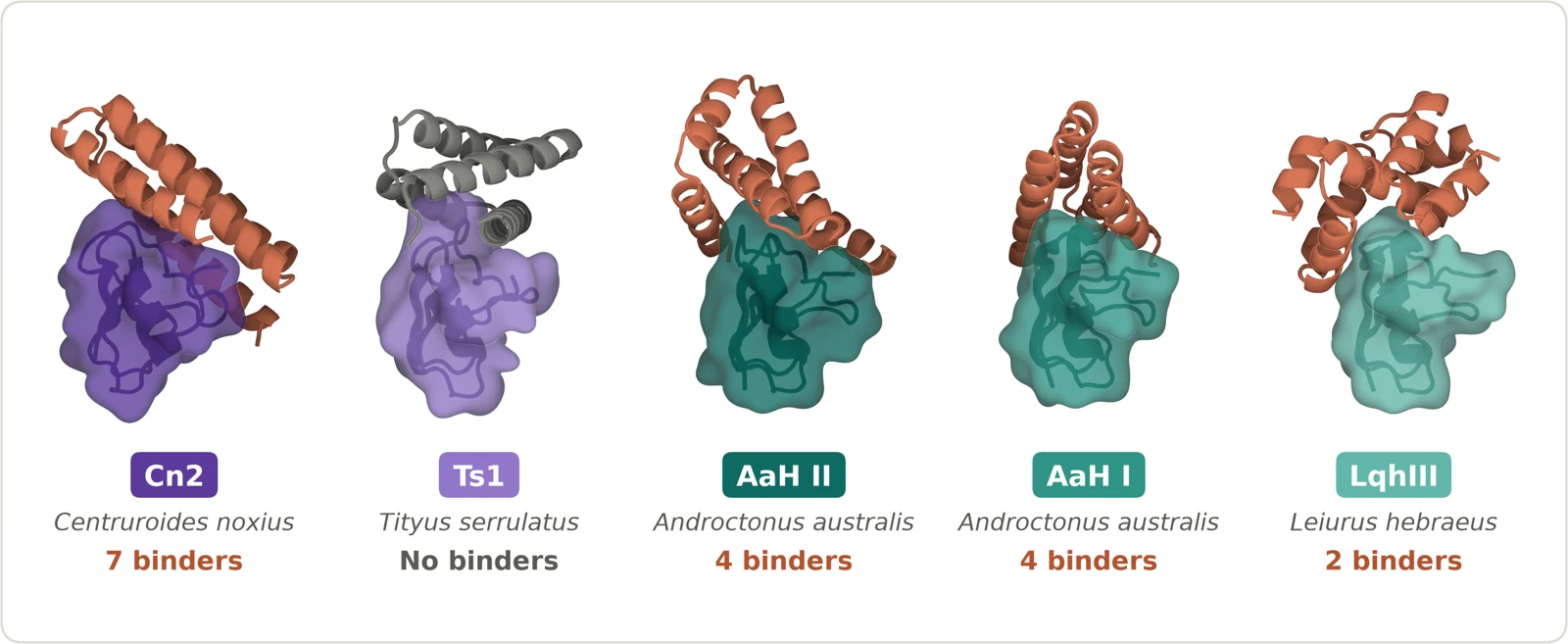
Open the molecular figure at full size.
What the lab measured, and what remains to be tested
Adaptyv Bio and Twist Bioscience evaluated candidate binding. For toxins measured at both centers, the criteria required consistent results and controls to rule out proteins that stick nonspecifically. LqhIII is the exception: only Adaptyv Bio measured it. Presenting all 17 as having identical cross-lab validation would miss that qualification. Report methods and results.
The tests used recombinant toxins, produced in a laboratory. This lets researchers study a particular interaction; checking behavior against toxins purified from natural venom is another step still ahead.
A useful way to read the evidence is to separate these questions:
| Question | Status in this study |
|---|---|
| Does the protein bind the toxin in the assay? | Yes: 17 designs met the criteria. |
| Does it stop the toxin from disrupting a cell’s function? | Not tested for these designs. |
| Does it protect an animal exposed to the toxin? | Not tested for these designs. |
| Is it a safe, effective treatment for people? | No such clinical result is available. |
The structural and competition analysis provides an interesting lead: some binders appear to occupy a region close to that of an antibody known to neutralize one toxin in mice. That observation supports a hypothesis about how they might work. Functional testing of the new designs is still pending.
One concrete example is Cn2-B1, a binder designed with RFdiffusion3. The report describes competition tests with known antibodies to investigate where it binds Cn2. The displayed structure of the complex remains a prediction. Together, these tests guide research into its possible function; neutralization by this design still needs to be measured. Case and figure in the report.
Did Claude do it alone? What the 64 hours mean
The computational campaign received an initial prompt and four follow-ups. Claude chose strategies and coordinated tools, while people defined the problem, supervised the work and arranged the laboratory stage. Citrini Research’s account, from a project collaborator, places the experience within several months of work with Anthropic.
The 64 hours cover design and the initial selection of 180 candidates, not the development of a treatment or the entire physical validation. Another 31 designs were added with Claude’s help. The report puts campaign compute at roughly 10,000 H100 GPU-hours: accumulated computing resources, not 10,000 hours of one person waiting. Report discussion and limitations.
The report describes Claude choosing how much to use each tool and how to filter and rank candidates within rules set by the team. This is autonomy within a specific problem, toolset and set of criteria. The laboratories then supply the physical check that a computational prediction cannot replace.
Anthropic, OpenAI and DeepMind: examples that reached a lab
Other teams have connected AI to physical tests too. This comparison distinguishes what was measured, because a binding rate and a production saving answer different questions.
| Work | Published experimental result | How to read it |
|---|---|---|
| Anthropic · internal Claude · October 2026 | 17 designs met binding criteria against scorpion toxins. | Binder discovery; neutralization still pending. |
| Google DeepMind · AlphaProteo · September 2024 | Binders for seven targets; some also blocked SARS-CoV-2 infection in cellular tests. | Specialized system and different targets. It did not produce binders for an eighth target, TNFα. |
| OpenAI + Retro · GPT-4b micro · August 2025 | More than 50 times the expression of cellular reprogramming markers versus controls, according to OpenAI. | Specialized experimental model; the indicator measures neither human longevity nor toxin binding. |
| OpenAI + Ginkgo · GPT-5 · February 2026 | More than 36,000 tested compositions and a 40% reduction in protein production cost versus its baseline. | Synthesis optimization in a robotic lab; not a drug-discovery success rate. |
Original sources: AlphaProteo and its tests, GPT-4b micro and Retro, GPT-5 and Ginkgo and the Claude data.
The common thread is a measurement outside the model’s generated text. Goals, tools and conditions differ enough that these results cannot establish a winner between Claude, Gemini and ChatGPT. Nor do experimental systems automatically establish the capabilities of commercial models from the same provider.
Why this result deserves attention
The study addresses a neglected health problem: its authors cite estimates of more than 1.2 million scorpion stings a year, with barriers to care and antivenom access in several regions. Accelerating candidate discovery can be valuable even with a long path to treatment ahead. Health context and references in the report.
For the study, the next decisive step would be testing whether the binders block the toxins’ effects. For the next commercial model, the question is how much of the judgment described by the tester reaches a release others can evaluate. Today there is a tester’s account of that Claude and experimental data from an internal system. Each supports following a different development.
Anthropic · October 20, 2026. Original announcement of the scorpion-toxin protein study. Read the announcement and thread on X ↗
Source
Plan your next post in HeyMark.
Keep the idea, review the draft with your team, and see how it performed in the accounts you connected.