News Google
Google Expands Access to SynthID Detector in English
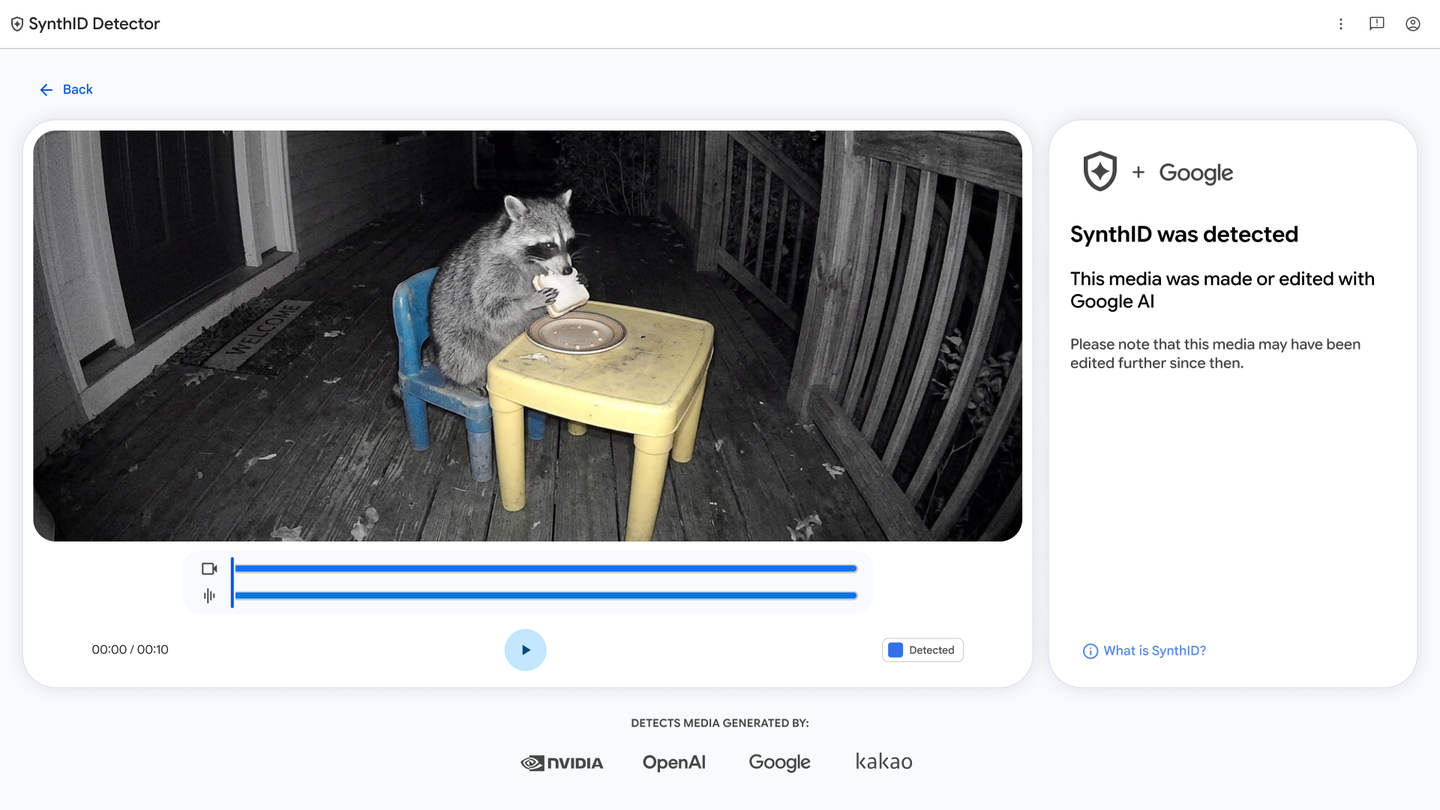
On October 7, 2026, Google announced the start of global access to SynthID Detector in English for checking certain media with compatible provenance marks. Google’s announcement says the tool can check images, videos, and audio associated with SynthID.
What media can SynthID Detector check?
Google describes checking images, videos, and audio that include SynthID marks. The announcement cites marks from Google and partners such as OpenAI, NVIDIA, and Kakao. This defines the tool’s scope: it is not presented as a detector that can recognize any image, video, or audio generated with artificial intelligence. If the media does not carry a compatible signal, the announcement’s description does not make it possible to determine its origin. Information about formats and partners appears in the official announcement.
For a social media team, a potential use is checking received material or a piece before publishing it, provided there is a reason to verify its provenance. This might be content sent by a collaborator, an image being added to a post, or a video under review. It does not replace editorial checks for rights, context, or accuracy; those are separate questions from whether a compatible mark is detected.
When can people access it, and in what language?
The announcement says global access in English begins “today,” referring to October 7. This confirms the start announced for that date, but does not establish that all languages are available or that every person or team has access under the same conditions. Google describes access as global in English starting October 7.
If your team works in Spanish, the announced access language is a constraint to keep in mind when evaluating the tool. Before adding it to a routine review process, check that it is accessible for your use case and that the file types you work with can be checked. Do not assume that a check that finds no mark confirms that a person created the media.
What can and can’t the tool prove?
The announcement supports describing a check for compatible SynthID signals across several formats. It does not support treating the result as a general certification of authenticity or using it as the sole basis for deciding whether to publish. The tool should be understood as one piece of information in a broader editorial process, not as a complete judgment about the content.
A practical process can separate the question “Is a compatible mark detected?” from “Do we have permission to use this piece?” and “Is it accurate for our audience?” These are different checks. It also helps to record what was reviewed and who made the decision, especially if several people are involved in receiving and publishing content.
Confirmed by Google: the start of global access in English on October 7 and the ability to check images, videos, and audio with compatible marks. Important limitation: it is not a universal detector of AI-generated content. HeyMark has not yet tested SynthID Detector. To integrate an AI task into a creation workflow without confusing the tools, see the guide to connecting Claude with HeyMark; HeyMark does not verify SynthID marks.
Source
Plan your next post in HeyMark.
Keep the idea, review the draft with your team, and see how it performed in the accounts you connected.