Blog
MRR vs ARR: definitions, differences and calculation
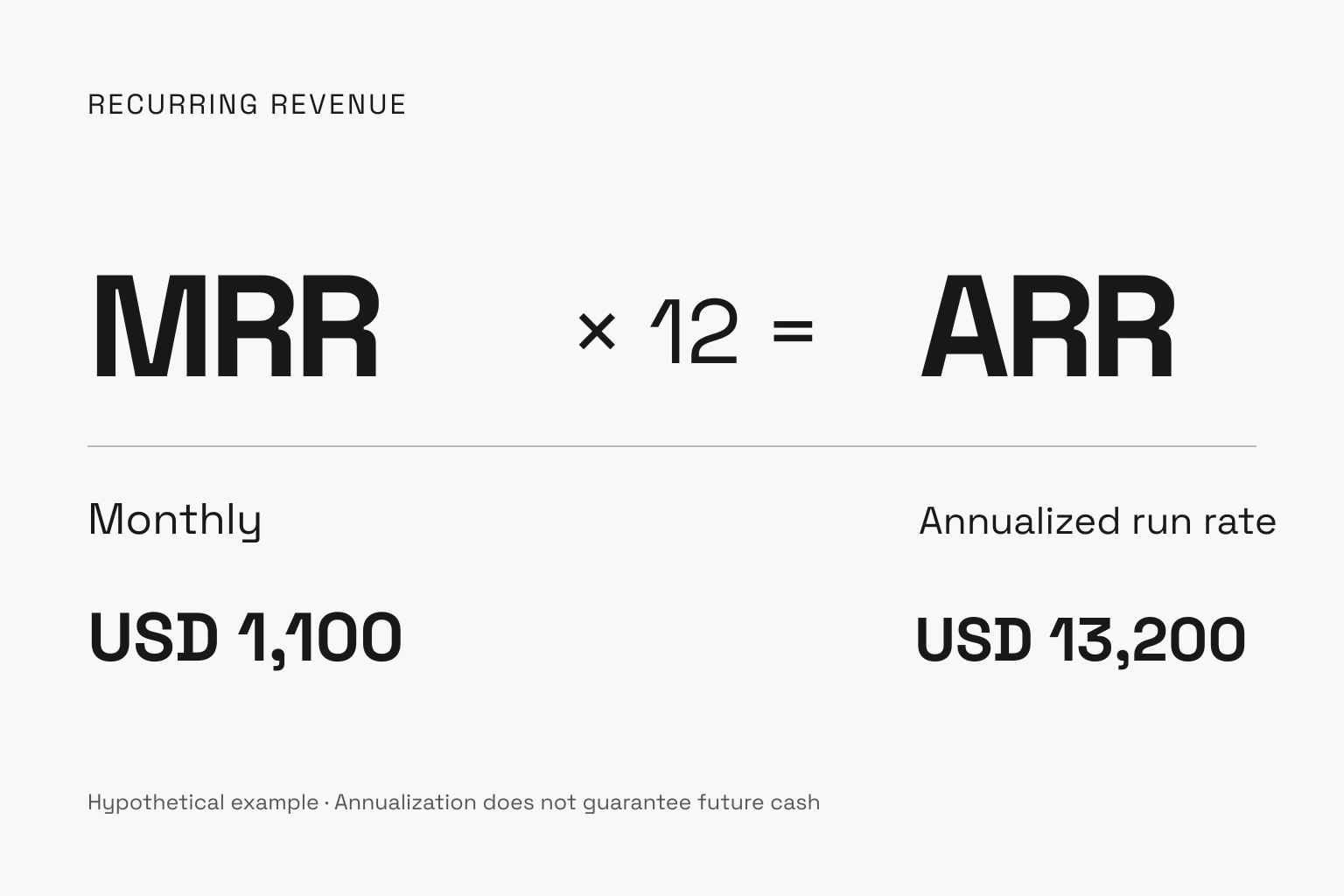
Monthly recurring revenue (MRR) is the normalized monthly value of active recurring subscriptions at a stated cutoff date. Annual recurring revenue (ARR) commonly annualizes that monthly base: ARR = MRR × 12. These metrics are for subscription businesses such as SaaS. They do not, by themselves, describe one-off sales, recognized accounting revenue or cash collected.
How do you calculate MRR and ARR?
First define which contracts and components count as recurring, and how you will normalize monthly and annual billing. Exclude one-time charges unless your policy explicitly says otherwise. Do not add both a contract’s full annual value and its monthly installments.
For example, an annual recurring contract of USD 1,200 contributes USD 100 to MRR (1,200 ÷ 12), rather than USD 1,200. A one-time USD 50 setup charge stays outside that recurring base. Apply discounts consistently with your stated policy.
Hypothetical example: a SaaS company starts October with MRR of USD 1,000. It adds USD 150 from new subscriptions and USD 50 from expansion, then loses USD 30 through contraction and USD 70 through cancellations. Closing MRR is 1,000 + 150 + 50 − 30 − 70 = USD 1,100. Closing ARR run rate is 1,100 × 12 = USD 13,200.
MRR bridge and ARR calculator
Reconcile opening and closing monthly recurring revenue. Enter monthly-normalized movements without double-counting.
The calculation assumes comparable amounts in one currency, a stated cutoff date and a consistent policy for subscription status, discounts, credits and taxes. Stripe documents operating conventions for its Billing product, including subscription status and coupons; those are platform rules, not a universal standard. See its MRR and ARR explanation.
What is the difference between MRR and ARR?
MRR shows the current recurring base under your stated policy. ARR annualizes that base to express a yearly run rate. The USD 13,200 ARR in the example does not mean the company collected that amount in October or will receive it over the next twelve months. It assumes the current recurring base and prices continue.
To explain what changed, show a bridge from opening to closing MRR: new subscriptions, expansion, contraction and cancellations. State the cutoff date, currency and inclusion rules. In this example, net change is USD 100; that total does not replace the movement breakdown.
Is MRR the same as revenue or cash?
Not necessarily. MRR is an operating measure of recurring revenue; it is not, by itself, revenue recognized under an accounting policy or cash received. An annual invoice may be paid upfront while accounting revenue is recognized on a different schedule. For cash, review invoices, payments, refunds and due dates; for recognized revenue, follow the applicable accounting policy.
Use MRR and ARR when you run a subscription business and can keep a stable definition. Do not treat ARR as a forecast of renewals, growth or cash: churn, price changes, discounts and seasonality can change the base.
For another view of subscription economics, see customer retention rate.
Plan your next post in HeyMark.
Keep the idea, review the draft with your team, and see how it performed in the accounts you connected.