News Theories
Introducing two theories: GPT-6.2 Bel
Welcome to the launch X is imagining. The cover is our launch satire; the article investigates the clues. At this review’s cutoff on November 4, 2026, we have located no official announcement of GPT-6.2 Betelgeuse in OpenAI’s model catalog or changelog.
The name circulates as “Bel,” a screenshot says gpt-6.2-betelgeuse, Tibo posts “Le GPT Fat,” and two unannounced API IDs appear. It is understandable to want to connect them. The interesting question is which links have evidence and where interpretation begins.
One recent data point deserves a closer look: OpenAI showed an unnamed internal model outscoring Astra on an engineering test. That can inform a theory. Identifying the model requires further evidence.
The real benchmark behind the theories
On BenchCAD 2.0, OpenAI reports 0.875 for its internal model and 0.594 for GPT-6 Astra, the latter at its highest reasoning setting. The test combines reconstruction of 3D parts and assemblies with circuit-board connections. The source leaves the internal model unnamed.
BenchCAD 2.0 · OpenAI · Nov 3, 2026
Astra versus the internal model
9 published values · 100 cases per point · different evaluation harnesses.
- GPT-6 Astra highest reasoning setting
- Unnamed internal model
Mean BenchCAD 2.0 score (0 to 1) · higher is better
Cost proxy, log scale · 1× = Astra at maximum effort
Tap or focus a point to read it.
Exact difference between the two quoted figures
- Absolute difference
- +0.281
- Relative change
- +47.3%
0.875 − 0.594. That is 28.1 points out of 100 on this 0-to-1 scale.
0.281 ÷ 0.594. Arithmetic on the average of a single test: it does not mean “47% better at everything”.
The proxy applies Astra pricing to the internal model; it is not measured compute or its commercial price. Evaluation harnesses differ. Not identified as GPT-6.2.
See all 9 valuesScore and relative proxy
| Point | BenchCAD 2.0 | Cost proxy |
|---|---|---|
| GPT-6 Astra | ||
| 1 of 5 | 0.135 | 0.04× |
| 2 of 5 | 0.309 | 0.247× |
| 3 of 5 | 0.406 | 0.462× |
| 4 of 5 | 0.449 | 0.604× |
| 5 of 5 | 0.594 | 1× |
| Unnamed internal model | ||
| 1 of 4 | 0.758 | 0.977× |
| 2 of 4 | 0.831 | 2.054× |
| 3 of 4 | 0.854 | 3.086× |
| 4 of 4 | 0.875 | 3.376× |
- The internal model has no public name. OpenAI has not identified it as GPT-6.2, “Betelgeuse” or “Bel”.
- We do not include Claude or other models: no comparable BenchCAD 2.0 results are published.
- Astra’s 95.9% on BenchCAD (v1) is a different version of the test and is not comparable with these figures.
- Each point covers 100 cases. Case-level scores and the internal model’s configuration are not published. The proxy is not measured compute, and there is no independent evaluation.
Switch between the curve and the exact difference, show intermediate points and inspect each value. All nine scores and their cost proxies are published in the chart’s embedded data. Two figures, 0.594 and 0.875, are also quoted in the text. Each point covers 100 cases; the source declares different evaluation harnesses and publishes neither case-level scores nor variance.
The horizontal axis uses a relative index on a logarithmic scale: 1× for Astra at maximum effort and 3.376× for the internal model’s 0.875 point. OpenAI applies Astra pricing to calculate the internal model’s proxy. This index is not measured compute, dollars per task or its commercial price. We also leave reasoning levels unspecified where the source does not identify them.
The 0.281 difference and 47.3% relative increase come from subtracting and dividing those two means. They describe this metric and these evaluation systems; they do not isolate the model’s contribution from its harness. Projecting other benchmarks would require an explicit assumption about how the gain transfers between tasks. That relationship has not been published.
Correction · November 4: we replaced the initial seven visual readings with all nine numeric source values. We added their cost proxies, the 100 cases per point and the warning about different harnesses. These results still belong to an unnamed internal model.
GPT-6 Astra, Sol and GPT-6.2: the comparison
The comparison published with Sol 6.1 includes six tests with Astra and Sol at several reasoning settings. Each pair comes from that same publication, alongside its average evaluation cost per task. Astra’s original launch page contains earlier evaluations and some different values.
Benchmarks
GPT-6 Astra, Sol and GPT-6.2
Compare scores and mean cost per task at five effort levels.
- GPT-6 Astra
- GPT-6.1 Sol
- GPT-6.2
Score · higher is better
Mean cost per task (US$), log scale
DeepSWE · Summary · Max effort
| Series | Score | Cost per task |
|---|---|---|
| GPT-6 Astra | 73.23% | US$7.50 |
| GPT-6.1 Sol | 71.9% | US$1.57 |
| GPT-6.2 | 80% | US$25.31 |
How the figures are calculated
Anchor: on BenchCAD 2.0, an unnamed OpenAI internal model scored 0.875 against Astra’s 0.594 at maximum effort. Different evaluation harnesses, 100 cases per point; that chart’s cost axis is a proxy using Astra pricing, not measured compute.
- Anchor advantage on the logit scale: Δ = logit(0.875) − logit(0.594) ≈ 1.57.
- For each test and effort: p = logistic(logit(Astra score) + k·Δ). k is the share of that advantage that transfers: 1 is all of it, 0 none, and a negative value a setback.
- 10,000 draws of k per assumption from a fixed pseudo-random generator (mulberry32, seed 20261104), so results are reproducible. We chose the k distribution; it is not a calibrated prior.
- The displayed figure is the central value of 10,000 calculations under that assumption, rounded to whole percentage points. It is not a calibrated probability or a 100-case trial.
- Applying this difference to other tests and Astra’s five reference effort levels is an assumption. Maximum effort is declared only for Astra; the internal model’s setting is unpublished.
- Budget hypothesis: GPT-6.2 cost = Astra mean cost per task × 3.376. The multiplier comes from the BenchCAD 2.0 proxy; applying it to other tests and efforts is a HeyMark assumption, not a measured relation or commercial price. It does not identify the internal model as GPT-6.2.
- Scenarios are shown in whole percents; published data keep the source precision. The factual error rate (lower is better) shows real data only.
The GPT-6.2 curve uses k uniform on [−0.5, 1] and shows the median from 10,000 draws with a fixed seed.
See all figures6 tests · 5 efforts · score and cost
| Effort | GPT-6 Astra | GPT-6.1 Sol | GPT-6.2 | |||
|---|---|---|---|---|---|---|
| Score | Cost per task | Score | Cost per task | Score | Cost per task | |
| DeepSWE | ||||||
| Low | 67.04% | US$1.60 | 64.38% | US$0.17 | 75% | US$5.39 |
| Medium | 72.79% | US$3.08 | 73.01% | US$0.42 | 80% | US$10.38 |
| High | 73.23% | US$3.92 | 75.22% | US$0.65 | 80% | US$13.25 |
| Very high | 74.12% | US$4.43 | 71.9% | US$0.79 | 81% | US$14.95 |
| Max | 73.23% | US$7.50 | 71.9% | US$1.57 | 80% | US$25.31 |
| GDP.pdf | ||||||
| Low | 30.4% | US$1.70 | 27% | US$0.33 | 40% | US$5.73 |
| Medium | 30.4% | US$1.72 | 30% | US$0.34 | 40% | US$5.81 |
| High | 31% | US$1.79 | 32% | US$0.35 | 40% | US$6.06 |
| Very high | 32.2% | US$1.91 | 31.8% | US$0.37 | 42% | US$6.46 |
| Max | 31% | US$2.08 | 31% | US$0.42 | 40% | US$7.01 |
| AutomationBench | ||||||
| Low | 30.3% | US$1.08 | 24.7% | US$0.16 | 39% | US$3.65 |
| Medium | 34.1% | US$1.27 | 31.7% | US$0.19 | 44% | US$4.29 |
| High | 37.1% | US$1.44 | 33.2% | US$0.23 | 47% | US$4.86 |
| Very high | 39% | US$1.50 | 35.5% | US$0.25 | 49% | US$5.06 |
| Max | 41.4% | US$1.73 | 36.1% | US$0.30 | 51% | US$5.84 |
| OSWorld 2.0, offline set | ||||||
| Low | 62.17% | US$2.72 | 58.96% | US$0.42 | 71% | US$9.17 |
| Medium | 69.25% | US$5.36 | 66.84% | US$0.77 | 77% | US$18.09 |
| High | 70.02% | US$6.91 | 69.56% | US$0.96 | 78% | US$23.32 |
| Very high | 71.27% | US$7.49 | 69.38% | US$1.05 | 79% | US$25.30 |
| Max | 73.49% | US$9.44 | 71.42% | US$1.27 | 81% | US$31.85 |
| Terminal-Bench Science 0.1 | ||||||
| Low | 55.43% | US$11.41 | 43.71% | US$1.79 | 65% | US$38.51 |
| Medium | 57.43% | US$12.34 | 47.56% | US$2.34 | 67% | US$41.65 |
| High | 62% | US$14.95 | 51.14% | US$2.76 | 71% | US$50.48 |
| Very high | 60.86% | US$15.76 | 53.71% | US$2.89 | 70% | US$53.19 |
| Max | 68.1% | US$23.80 | 57.02% | US$5.47 | 76% | US$80.34 |
| Factual error rate on hard prompts · Error rate (lower is better) | ||||||
| Low | 6.26% | US$0.24 | 7.72% | US$0.05 | — | US$0.82 |
| Medium | 4.41% | US$0.31 | 6.29% | US$0.06 | — | US$1.05 |
| High | 3.9% | US$0.48 | 4.52% | US$0.08 | — | US$1.61 |
| Very high | 3.99% | US$0.60 | 4.12% | US$0.10 | — | US$2.04 |
| Max | 3.91% | US$0.79 | 4.61% | US$0.13 | — | US$2.66 |
The clues around Bel, Betelgeuse and rc-ada
Open each clue for its original source, what it shows and the inference it would require. We include the claim that the rumor was a hoax: that account has limits too and deserves the same scrutiny.
Evidence map
Six clues and what each one does not prove
Dated clues and counter-signals, each with date, author and source. Open one to see what it shows and where it stops.
Official · verifiedOpenAI shows an unnamed internal model on BenchCAD 2.0
- What it shows
- In its November 3 post, OpenAI quotes a mean score of 0.875 for a newer internal model, against 0.594 for GPT-6 Astra at its highest reasoning setting.
- What it does not prove
- It does not call it GPT-6.2, Betelgeuse or Bel, nor announce a launch. Its chart covers 100 cases per point with different harnesses. Individual scores, configuration and the internal model’s commercial price are unpublished; there is no independent evaluation.
- HeyMark reading
- It is the only benchmark in this list with a primary source. Its data do not identify the internal model as GPT-6.2.
- Sources
Unauthenticated screenshotA third-party tracker shows “gpt-6.2-betelgeuse”
- What it shows
- A screenshot from a Discord bot called “Internal Tracker” listing the string gpt-6.2-betelgeuse as internal. It drew roughly 568k views.
- What it does not prove
- The tracker is not OpenAI’s and the screenshot has no verifiable provenance: no endpoint, no callable model, no response.
- HeyMark reading
- It proves the name is circulating, not that it exists inside OpenAI.
- Sources
AmplificationThe account that amplified it opens with “Cant confirm”
- What it shows
- It quotes the tracker screenshot and frames it as a “GPT-6.2 bel” on the way. It drew about 130k views.
- What it does not prove
- The author says they cannot confirm it. Linking “Bel” to “Betelgeuse” is their interpretation. The original “Bel” comes from an anonymous account that, in August, described a pretrain above 10T parameters; none of that is confirmed.
- HeyMark reading
- Reach grew; evidence did not.
- Sources
Disputed counter-signalA counter-story says Betelgeuse was a hoax
- What it shows
- TokenGremlin claimed the name was invented to test how easily unverified leaks spread. The story reached Reddit on November 1.
- What it does not prove
- It relies on third-party messages that have no source either. It does not prove the name is fake, just as the screenshot does not prove it is real.
- HeyMark reading
- We treat it as a disputed account, not a debunk.
Employee · ambiguousTibo’s cryptic posts
- What it shows
- Tibo posted “Day 28/ Banked 2/2” as part of a daily challenge, then “Le GPT Fat” and “ChatBLT”. Part of the community read them as hints of a new model.
- What it does not prove
- None mentions a name, size or date. The challenge promised a ship or a limits reset each day, not a model. Reading “fat” as “big pretrain” is interpretation.
- HeyMark reading
- A real signal from a real person, with no verifiable content.
Multiple observersTwo IDs appear and vanish from the API list
- What it shows
- Several authors reported seeing rc-ada-or-vm and rc-ada-sh-vm in the API model list.
- What it does not prove
- Neither ID contains “6.2” or “betelgeuse”. Reading “rc” as release candidate and “vm” as sandbox are guesses by those who saw them.
- HeyMark reading
- The reports agree on the identifiers. Their purpose and connection to a specific model remain unconfirmed.
Editorial cut-off: Nov 4, 2026, 12:54 Santiago time (15:54 UTC). At the cut-off, OpenAI’s API model catalog and changelog did not list GPT-6.2, betelgeuse or Bel. We assign no confidence percentages: each clue states what it shows and where it stops.
Chronology matters. The August “Bel” rumor predates November’s chart. The third-party tracker follows on October 29. The rc-ada-or-vm and rc-ada-sh-vm IDs and the new benchmark appear later. These conversations converging this week does not establish that they describe the same model.
Bel was also read as Bellatrix
There is another reading of the name that predates the Betelgeuse screenshot. On August 25, @CiprianiMacovei replied to ChrisGPT with “Bel from Bellatrix.” That is a user’s interpretation. The post does not confirm an OpenAI name or a connection to GPT-6.2.
ESA’s astronomy guide describes Bellatrix as bluish, spectral type B2 III, and Betelgeuse as red, type M2 Iab. ESO’s diagram also places them in very different regions of luminosity and size. Both are larger than the Sun, with different physical characteristics. They mark Orion’s two shoulders in our sky; sharing a constellation describes their apparent positions, not a short physical distance between them.
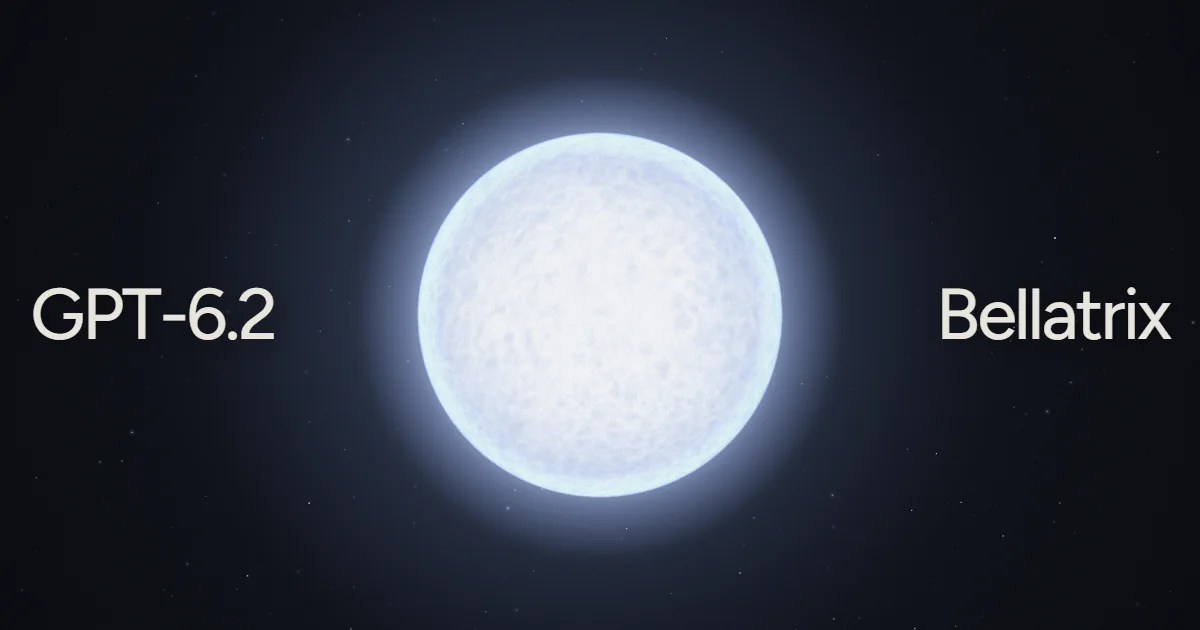
The cover travels between the two readings of Bel: orange for Betelgeuse and blue for Bellatrix. The displayed sizes are illustrative and have no astronomical scale. OpenAI choosing either name, or introducing more than one model, remains an open possibility. There is also no evidence for assigning separate capabilities, prices or scores to them. The nickname and color cannot establish a release plan.
Three ways to connect the signals
The new-generation hypothesis. Some users interpret Bel as a larger training run, take the Betelgeuse screenshot as its name and read the internal model as its first public result. The story fits together, but needs two bridges: authenticating the screenshot’s origin and linking that identifier to the evaluated model. None of the consulted sources establishes both.
The research or product-testing hypothesis. An internal model can support research or a specialized experience. Two observed API identifiers can represent separate experiments. This reading explains the signals without requiring an imminent general release. It remains a hypothesis as well.
The self-amplifying rumor hypothesis. A screenshot spreads, parameter counts and prices are added, and repetition starts to resemble fresh confirmation. TokenGremlin’s counterclaim says the name was invented. That explanation depends on private messages we cannot verify. It challenges the story without settling it.
The numbers still lacking support
An October 30 post assigns the rumored model 12T parameters, 72 on Artificial Analysis and a $20/$100 per million token price. It invokes an unnamed insider. These remain that account’s claims. We found no official Betelgeuse model card or verifiable result allowing them to be used as specifications.
BenchCAD 2.0 also needs to stay separate from the 95.9% BenchCAD result in Astra’s launch presentation. Those are different versions. An attractive chart can easily conceal that distinction; this edition keeps the version next to the score.
What would change the story’s status
A changelog entry, model card and announcement connecting a name to capabilities would change the situation. Assessing performance would also require tasks, benchmark version, configuration, tools and cost. A selector screenshot or a model’s self-reported name does not complete that check.
If you already use current models, see our coverage of GPT-6.1 Terra and Astra Pro. Those tests and conditions refer to identified products. This edition keeps theories labeled and sources one click away, so you can follow the trail without turning every teaser into a release date.
Source
Plan your next post in HeyMark.
Keep the idea, review the draft with your team, and see how it performed in the accounts you connected.